Clay, Fibre or Found Wood for a Small Coastal Still Life
Choose clay, fibre or found wood for a small coastal still life by matching surface, silhouette and visual weight to the objects you want to emphasize.
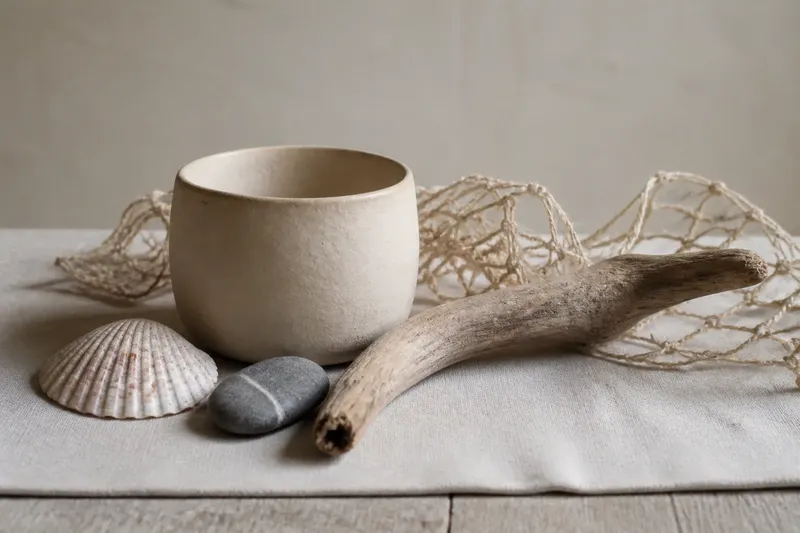
Which material will make a small coastal still life feel most like itself: clay, fibre or found wood? For a small coastal still life, the choice is less about naming the shore than deciding what the eye should notice first—a rounded vessel, a loose knot, or a weathered edge.
Begin with the focal point
Set out the objects you might include: a shell, a smooth stone, a scrap of net, a little jar. Notice which one already holds attention. A material can echo that object, or provide a deliberate counterpoint.
Clay gives a composition a compact, settled center. A small hand-built cup or low bowl can make a shell look lighter and more delicate beside it. Fibre, by contrast, tends to draw attention through strands, loops, and gaps. Found wood contributes a directional shape: grain, a broken end, or a bend can lead the eye across the arrangement.
Keep the scale modest in mind. In a small work, one strong texture often reads more clearly than several competing ones. If the shell has a ridged surface, for instance, pair it with a plain clay form or a quiet piece of wood rather than adding a second highly knotted object.
Clay holds a quiet weight
Clay suits still lifes that need a sense of mass. Even an unglazed form can show subtle shifts from a thumb-smoothed curve to a cut rim. Its solid silhouette gives fragile or irregular beach objects a visual resting place.
Choose a surface in relation to the rest of the scene. A smooth, pale clay form can set off the porous edge of a stone; a rougher surface may sit comfortably beside driftwood. Avoid adding decorative marks simply to make the piece look “coastal.” A restrained profile often leaves more room for the actual objects to speak.
Clay is less suited to a composition whose main interest is openness or movement. A large, solid shape can close the gaps that make a tangle of net or sea grass feel airy. If you want that sense of space, use a smaller clay element or let it sit at the edge rather than at the center.
Fibre makes lines visible
Fibre brings line and transparency into the arrangement. Linen thread, a narrow strip of cotton, or a small woven scrap can trace a curve without filling the space beneath it. Those openings matter: they let the ground and neighboring objects remain part of the composition.
Different fibres suggest different kinds of attention. A neatly woven piece emphasizes pattern and repeated crossings; loose cord or unraveling fabric emphasizes direction and fray. A few strands may be enough to suggest a net without turning the whole work into an illustration of fishing gear.
Fibre can also become visually busy. Lay it beside the other objects before deciding how much to use. If its loops hide the outline of a shell, simplify the arrangement or choose a more open weave. The useful question is not how much material belongs in the work, but which lines deserve to remain visible.
Found wood directs the gaze
Found wood offers an irregular contour that manufactured materials rarely provide. A short piece of driftwood can point toward a shell, frame a small vessel, or divide the scene into calm and active areas. Grain and worn surfaces contribute detail, but the outer silhouette usually does the stronger work.
Look for a piece whose shape supports the composition rather than merely signaling the beach. A blunt, compact fragment may act like a low platform; a thin, curved piece may serve as a line across the scene. Too many branches or splinters can make a small still life feel crowded, so choose a piece with one readable gesture.
Found materials can carry grit, moisture, or other residue. For a display or artwork, select and prepare them in a way appropriate to their intended use, and follow any relevant material guidance. The visual decision remains simple: retain the weathered character, but do not let incidental debris become the focal point.
How do the materials compare?
Which material gives the strongest focal point?
Clay usually creates the clearest block of visual weight, so it can anchor loose or delicate objects. Found wood can also command attention, but its pull comes more from shape and direction than from mass.
Which material keeps the composition airy?
Fibre is the natural choice when you want lines and openings to remain visible. Found wood can also leave space around itself, while a broad clay form tends to occupy more of the scene.
Can the materials appear together?
Yes, if each has a distinct job: clay for a stable center, fibre for a fine line, and wood for a directional edge. Say you have a small shell and a plain cup on a tabletop; an invented arrangement might add one curved wood fragment pointing toward the shell and a short length of open-weave fibre behind it, with the expected visual result that the shell remains legible while the two additions guide the eye without enclosing it.
What should I leave out?
Leave out a material that repeats a texture already doing enough work. Three expressive surfaces can compete for attention in a compact scene; one focal texture and one quieter counterpoint are often easier to read.
Choose by the space between
Before committing, arrange the materials on a plain board or sheet of paper and look at the gaps as carefully as the objects. Clay may make the open areas feel more precious; fibre can draw attention through them; wood can divide or connect them. The negative space is part of the still life, not leftover room.
It is not worth the effort to collect a perfect assortment of shore-found objects before beginning. A single shell, a cup, and one chosen material can reveal whether the composition needs weight, line, or direction; add another element only if the arrangement asks for it.
For a small coastal still life, choose the material that gives the central object the clearest relationship to its surroundings. Clay settles it, fibre lets it breathe, and found wood sets it moving. That decision can be more specific to a place than adding a decorative symbol of the sea.